
Fast Fashion Statistics — The Numbers Worth Knowing (2026)
Statistics about fast fashion circulate widely and vary significantly depending on the source, the year, and how broadly the industry is defined. This page collects the most cited, most reliably sourced figures — organised by category so they are useful for research, writing, or making a case — and updates them with the most current data available as of 2025 and 2026.
Every number here is attributed to its source. Where figures vary between studies, the range is noted rather than picking the most alarming version. The goal is accuracy, not shock. The reality of fast fashion’s impact does not need exaggeration — the verified numbers are already significant enough.
For the analysis behind these numbers — what they mean in practice, who absorbs the costs, and what can be done — see the companion articles on the social cost of fast fashion, the hidden costs of fast fashion, and the alternatives to fast fashion that are actually working.
Industry scale
The global fast fashion industry was valued at approximately $150 billion in 2024 and is projected to reach $291 billion by 2032, growing at roughly 10.7% annually. This growth is occurring despite increasing awareness of the environmental and social costs — indicating that awareness alone is not sufficient to change consumption patterns.
Global fibre production has almost doubled in two decades, from 58 million tonnes in 2000 to 116 million tonnes in 2022. Polyester now accounts for 57% of all global fibre production, up from just 3% of synthetic fibres in clothing in 1960. The shift from natural to synthetic fibres is one of the defining material changes of the past half-century in fashion.
Clothing consumption has also accelerated dramatically. People bought 60% more garments in 2014 than in 2000, while keeping each item for roughly half as long. The average garment is now worn between seven and ten times before being discarded — a decline of more than 35% over fifteen years.
The speed of the supply chain has compressed equally. In 2012, Zara could move a garment from design to shelf in approximately two weeks. Shein, the current market leader in ultra-fast fashion with a reported 50% market share of US online fast fashion, moves garments in as few as ten days and has been documented listing thousands of new styles every day.
Carbon emissions
The fashion industry is responsible for between 4% and 10% of total global greenhouse gas emissions annually — the wide range reflects the difficulty of measuring emissions across a supply chain that spans dozens of countries and multiple industrial processes. The UN Alliance for Sustainable Fashion and the European Parliament both cite figures at the higher end of this range.
The industry produces approximately 1.2 billion tonnes of greenhouse gases annually. To put this in context: this figure exceeds the combined emissions of all international aviation and maritime shipping globally.
Textile manufacturing alone is projected to increase its emissions by 60% by 2030 compared to 2015 levels if current production trajectories continue. If the fashion sector maintains its current path without structural change, its share of the global carbon budget could reach 26% by 2050, according to modelling by the Ellen MacArthur Foundation.
The dyeing and finishing processes — where colour and other chemicals are applied to fabric — are responsible for 3% of global CO2 emissions alone, in addition to contributing to water pollution. Along with yarn preparation and fibre production, these processes have the highest impacts on resource depletion across the supply chain.
Only four out of the 250 largest fashion brands have disclosed emission reduction targets that meet the level of ambition called for by the UN — a 55% absolute reduction by 2030 from 2018 levels. 57% of those brands show no clear progress on their climate targets at all.
Water
The fashion industry is the second-largest consumer of water among all industries globally, after agriculture.
Producing one cotton t-shirt requires approximately 2,700 litres of fresh water — enough to meet the drinking needs of one person for around 2.5 years. Producing one pair of jeans requires approximately 7,500 to 10,000 litres of water across the full supply chain, including cotton cultivation, dyeing, and finishing.
The textile sector uses approximately 93 billion cubic metres of water annually — equivalent to the consumption needs of five million people. Some estimates place the figure higher: the Geneva Environment Network cites 215 trillion litres of water per year across the full textile value chain.
The fashion industry accounts for 17 to 20% of all industrial wastewater pollution globally, according to the World Bank. Much of this wastewater — containing synthetic dyes, bleaches, and fixing agents — is discharged untreated into rivers and waterways in countries where factories are located. Textile factories in Dhaka, Bangladesh alone release an estimated 22,000 tonnes of toxic waste into rivers every year.
Textile dyeing ranks as the second-largest source of water pollution globally, after agriculture. The chemicals used in dyeing processes include heavy metals, formaldehyde, and other substances that are not biodegradable and contaminate local water sources long after production has moved elsewhere.
Textile waste
The fashion industry generates approximately 92 million tonnes of textile waste every year. More recent estimates from the Boston Consulting Group suggest the figure may already be closer to 120 million metric tonnes. Either way, the trajectory is upward: waste is projected to reach 134 million tonnes annually by 2030 if current production patterns continue.
The rate of waste generation is striking. The equivalent of a rubbish truck full of clothing enters a landfill or incineration facility somewhere in the world every second.
In the United States alone, approximately 11.3 million tonnes of textile waste enter landfills every year — around 85% of all textiles generated. The average American produces approximately 82 pounds of textile waste annually.
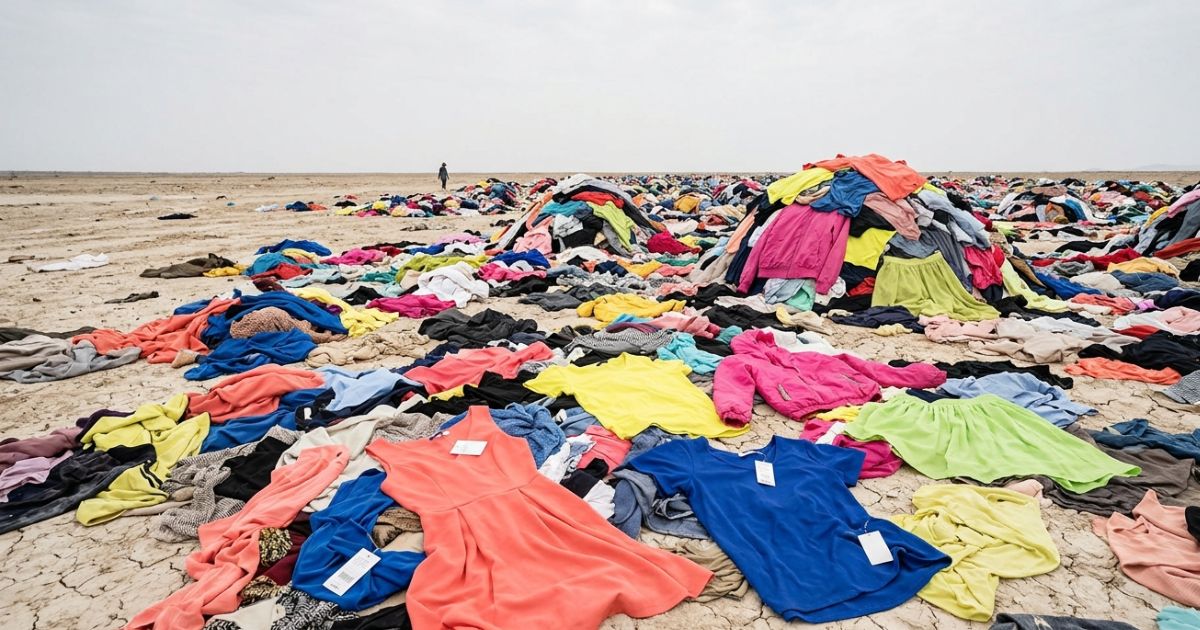
Globally, up to half of textile waste is exported to countries in the Global South — particularly in sub-Saharan Africa and South Asia — where it accumulates in landfills or open dumps, polluting local land and waterways. A landfill in the Atacama Desert in Chile has grown so large that it became visible in high-resolution satellite imagery.
Less than 1% of clothing is currently recycled into new clothing. The Ellen MacArthur Foundation estimates this results in over $100 billion in material value being lost every year. The Circularity Gap Report for textiles found that only 0.3% of the 3.25 billion tonnes of resources used annually in global textile production comes from recycled sources. The technology to recycle blended fabrics at scale does not yet exist commercially, which means most “recycled” clothing programmes redirect material to lower-value uses rather than back into garment production.
15% of fabric used in garment manufacturing is wasted during the cutting process alone — before a single garment reaches a consumer.
Microplastics
Approximately 60 to 70% of all clothing materials are now synthetic fibres — primarily polyester, nylon, and acrylic. These materials shed microplastic fibres during washing and drying.
Each wash cycle releases microplastic fibres into wastewater. A single polyester jacket has been estimated to shed up to 1.7 grams of microfibres per wash. Collectively, washing synthetic clothing releases approximately 500,000 tonnes of microplastic fibres into the ocean every year — equivalent in plastic pollution terms to more than 50 billion plastic bottles.
Synthetic clothing fibres are now the fourth-largest source of primary microplastics in the world’s oceans, accounting for approximately 8% of total ocean microplastic pollution. The share of synthetic fibres in clothing has increased from 3% in 1960 to approximately 68% today, meaning the scale of this problem is growing with every decade of production.
Microplastic fibres from clothing have been detected in drinking water, in marine life, in human blood, and in the placentas of unborn children. The long-term health implications of ingested microplastics remain an active area of research, with no established safe threshold currently identified.
Manufacturing synthetic fibres for fashion alone consumes at least 70 million barrels of oil every year, according to the European Environment Agency — approximately equivalent to one week’s worth of US oil production.
Labour and the human cost
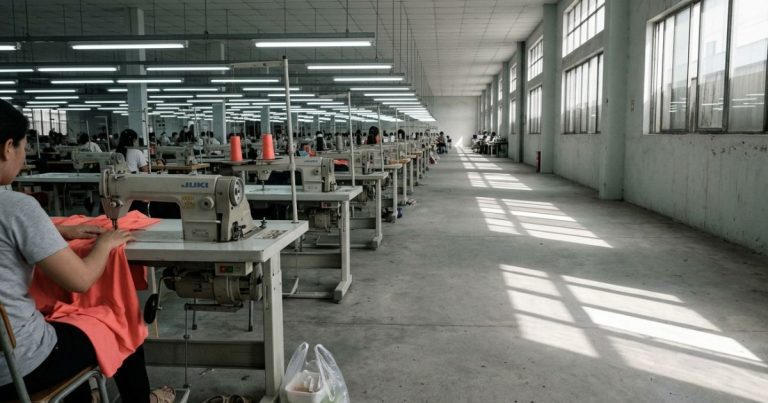
The fashion industry employs approximately 60 million factory workers globally. Around 75 to 80% of those workers are women, primarily aged 18 to 35.
Less than 2% of garment workers worldwide earn a living wage — the minimum required to cover food, housing, healthcare, and basic dignified living, as distinct from the minimum legal wage which is typically set far below this threshold. Research by the Clean Clothes Campaign confirms that no major clothing brand has been able to demonstrate that all workers in its supply chain receive a living wage.
In Bangladesh, the world’s second-largest garment exporter, the government raised the minimum wage for garment workers to $113 per month in late 2023, following protests that resulted in at least four worker deaths and more than a hundred arrests. Trade unions had called for $210 per month as the minimum required to lift workers above the poverty line. The Institute of Labour Studies in Bangladesh calculated a genuine living wage would require $302 per month.
In the United States, a Department of Labor investigation of garment contractors in California found that 80% were violating minimum wage and overtime laws. One contractor was found paying workers $1.58 per hour in a state where the minimum wage was $15.
On 24 April 2013, the Rana Plaza building in Savar, Bangladesh collapsed, killing 1,134 garment workers and injuring more than 2,500. The five factories it housed were producing garments for at least 29 global brands at the time. Large structural cracks had been identified the previous day; factory owners ordered workers back the following morning regardless. Rana Plaza remains the deadliest industrial disaster in garment industry history. For more on the structural conditions it revealed, see the full piece on the social cost of fast fashion.
During the COVID-19 pandemic, brands cancelled approximately $40 billion worth of completed orders from factories in producing countries, leaving millions of garment workers without pay for weeks or months. A Sheffield University study found that wages in the garment industry dropped by an average of 11% compared to pre-pandemic levels.
Greenwashing — the credibility gap
59% of green claims made by fast fashion brands, when examined by the Changing Markets Foundation, did not hold up to scrutiny. In some cases, including H&M, the proportion of misleading claims reached 96%.
A European Commission screening of websites found that half of green claims in the fashion industry lacked supporting evidence.
98% of the recycled polyester used by fashion brands — both fast fashion and self-described sustainable brands — comes from recycled plastic bottles rather than from recycled textile waste. This means recycled polyester does not reduce microplastic pollution from clothing, because the same synthetic fibres are shed during washing regardless of their origin.
Only 3 brands out of 250 major fashion brands surveyed publicly disclosed how many collective bargaining agreements existed across their garment supply chains to guarantee wages higher than legally required minimums.
What changes the numbers
Buying one used item of clothing instead of new has been estimated to save approximately 5.7 billion tonnes of CO2 emissions collectively if adopted at scale. If half of items bought in the UK were second-hand rather than new, it would prevent 12.5 billion kilograms of CO2 from entering the atmosphere annually.
Organic cotton uses approximately 91% less water and produces approximately 46% fewer carbon emissions than conventionally grown cotton.
A $150 ethically made garment worn 100 times has a per-wear environmental cost that is a fraction of a $40 fast fashion equivalent worn five times and discarded. Longevity is the most accessible route to reducing fashion’s environmental footprint that requires no new technology.
The brands that are not fast fashion guide lists verified alternatives across every clothing category. The alternatives to fast fashion page covers second-hand platforms, ethical directories, and the questions to ask. The facts about fast fashion page is the companion explainer to this statistics resource.
Key statistics at a glance
For quick reference and sharing:
Carbon: Fashion is responsible for 4-10% of global greenhouse gas emissions annually — more than all international flights and shipping combined.
Water: One cotton t-shirt requires 2,700 litres of water. The industry uses 93 billion cubic metres annually.
Waste: 92-120 million tonnes of textile waste generated every year. A rubbish truck of clothes enters a landfill every second.
Recycling: Less than 1% of clothing is recycled into new clothing.
Microplastics: 500,000 tonnes of synthetic fibres enter the ocean from clothing every year.
Labour: Less than 2% of garment workers earn a living wage. 60 million workers, 75-80% women.
Wear rate: The average garment is worn 7-10 times before being discarded — down 35% in fifteen years.
Greenwashing: 59% of fashion brand sustainability claims do not hold up to independent scrutiny.
Frequently asked questions
What percentage of global carbon emissions does fast fashion produce?
Between 4% and 10% of global greenhouse gas emissions annually, depending on how the industry is measured and which processes are included. The industry produces approximately 1.2 billion tonnes of CO2 equivalent per year — more than all international flights and maritime shipping combined. Emissions from textile manufacturing alone are projected to increase by 60% by 2030 if current production trajectories continue.
How much textile waste does the fashion industry produce each year?
Approximately 92 million tonnes per year, with more recent estimates suggesting the figure may be closer to 120 million metric tonnes. This is projected to reach 134 million tonnes annually by 2030. Equivalent to a rubbish truck full of clothing entering a landfill every second. Less than 1% of this material is recycled into new clothing.
How much water does fashion use?
The textile sector uses approximately 93 billion cubic metres of water annually. Producing a single cotton t-shirt requires around 2,700 litres of water. Producing one pair of jeans requires 7,500 to 10,000 litres. The fashion industry accounts for 17-20% of all industrial wastewater pollution globally.
What percentage of garment workers earn a living wage?
Less than 2%. Research consistently shows that the overwhelming majority of the approximately 60 million garment workers globally are paid below a living wage — the minimum required to cover food, housing, and healthcare. No major fashion brand has been able to demonstrate that all workers in its supply chain receive a living wage.
How many microplastics does fashion release into the ocean?
Approximately 500,000 tonnes of synthetic microplastic fibres from clothing enter the ocean every year — the plastic pollution equivalent of more than 50 billion plastic bottles. Synthetic fibres now account for approximately 68% of all clothing materials, up from 3% in 1960, making this an escalating rather than stable problem.
Related reading: