
A Mosaic Project Report. Current as of June 2026. Last updated 28 June 2026. Every figure links to its original source.
In one sentence: Fast fashion kept growing in 2026, reaching an estimated 178 billion dollars, even as the United States and the European Union closed the duty-free shipping loophole, the EU brought in producer-responsibility and anti-greenwashing laws, France passed a dedicated anti-fast-fashion law, and a generation of younger shoppers moved toward secondhand.
Key findings at a glance:
The global fast fashion market is projected to reach about 178 billion US dollars in 2026, on the way to 388 billion by 2034. Shein alone releases as many as 9,000 new designs a day, around three quarters of them virgin polyester. The US ended duty-free shipping of low-value parcels in August 2025, and the EU agreed a 3-euro per-item customs duty starting July 2026. Fewer than 2 percent of the world’s roughly 60 million garment workers earn a living wage. The global secondhand apparel market reached 393 billion dollars in 2025, growing nearly four times faster than new retail in the United States.
For two decades the story of fast fashion was a single line going up. More garments, made faster, sold cheaper, worn fewer times, thrown away sooner. That line is still climbing. What changed in 2026 is that parts of the world have finally started building walls in its path. Laws passed. Fines landed. A loophole that quietly underwrote the cheapest clothing on earth closed on two continents in the space of a year. None of it has bent the line back down. All of it says the line is no longer treated as a fact of nature.
This report gathers the most reliable current numbers and sets them against the year’s real developments. It is a companion to our standing fast fashion statistics page, which holds the verified baseline on carbon, water, waste, and wages. The focus here is movement: what grew, what broke, and what the coming rules will mean.
A note on the numbers. Market-size estimates for fast fashion vary widely between research firms, depending on how the sector is defined, from around 60 billion dollars to nearly 180 billion for the same year. Where a range exists, we have used the most conservative credible figure and named the source, so you can weigh it yourself. The regulatory and trade situations described below are still moving. The sections on customs and on the French law are the most likely to have shifted by the time you read this.
The industry kept growing, and so did its footprint
Fast fashion did not shrink in 2026. The global market was valued at roughly 163 billion US dollars in 2025 and is projected to reach about 178 billion in 2026, on a path toward 388 billion by 2034. Asia Pacific holds the largest regional share. The direction has not changed in years. Awareness of the harm has risen across the same period without slowing the spending, which is its own quiet verdict on how much information alone can do.
The shape of the market did shift. Shein, the Chinese-founded online retailer now headquartered in Singapore, remains the largest fast fashion retailer worldwide, with around an 18 percent global share of the category and roughly 38 billion dollars in sales. In the wider apparel industry it has climbed to third place behind only Nike and Adidas, ahead of Zara and H&M. But the hypergrowth years are cooling. Analysts now describe Shein and Temu, the US-headquartered marketplace owned by China’s PDD Holdings, as moving from hypergrowth to harder economics, with Shein’s annual growth slowing sharply as tariffs and scrutiny catch up.
The speed underneath the sales has not slowed at all. Deutsche Umwelthilfe, a German environmental watchdog, describes Shein releasing as many as 9,000 new designs every day, around three quarters of them virgin polyester. Greenpeace recorded peak days of more than 10,000 new products. A Stanford analysis found something counterintuitive about how this works. These companies are not actually faster than Zara at making and shipping clothes. They are faster at designing them, using data and machine learning to generate thousands of styles at once.
Around 9,000 new designs a day. Roughly three quarters of them are virgin polyester. That is one company, on an ordinary day.
More production means more emissions, whatever efficiencies are found elsewhere. Shein’s own reporting showed total emissions rising 23 percent in 2024. A business built on volume and speed cannot decarbonise by trimming the edges, because the volume is the emission. That is the problem no pledge has solved, and it is structural rather than fixable with a better recycled-polyester line.
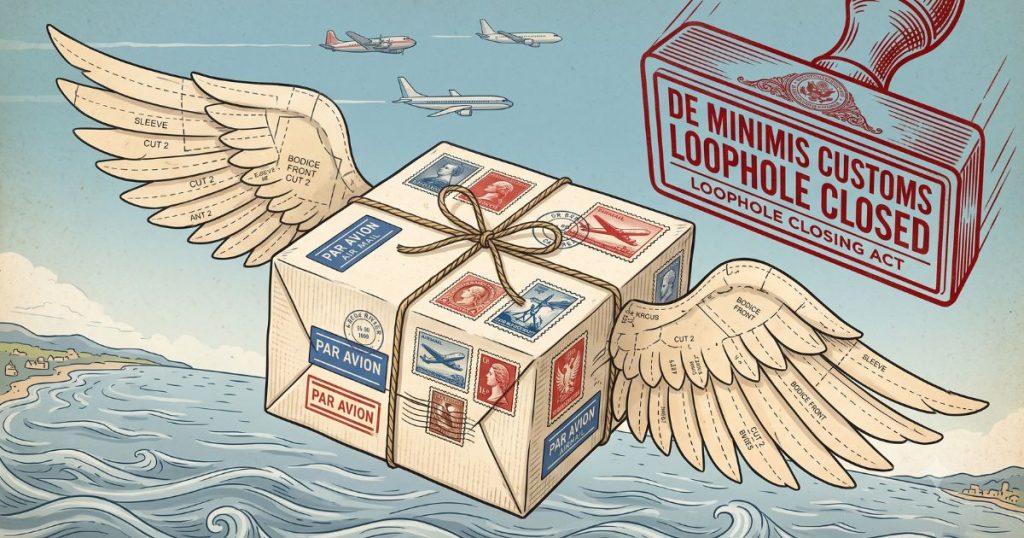
The cheap-shipping loophole closed on two continents
The biggest structural change of the past year was a customs rule. For years both the United States and the European Union let very low-value parcels enter with little duty and almost no inspection, a provision known in the US as de minimis. That arrangement was the quiet foundation of the direct-to-consumer model. It let Shein and Temu ship a parcel from a factory in Guangdong to a doorstep in Ohio or Lyon without paying import duty on it.
The foundation is going. In the United States, the de minimis exemption ended for China and Hong Kong on 2 May 2025, then for all countries on 29 August 2025. Around four million more packages a day are now subject to tariffs and customs processing that previously sailed through untouched. The National Bureau of Economic Research estimated the change could cost American consumers at least 10.9 billion dollars a year, around 136 dollars per family, with lower-income shoppers hit hardest.
Europe followed, and faster than anyone expected. The EU Council, the institution where member-state governments agree law, decided on 12 December 2025 to apply a fixed 3-euro customs duty on small parcels valued under 150 euros, starting 1 July 2026. The duty is charged on each different item in a consignment according to its tariff heading, so a parcel holding three distinct product types carries three charges rather than one. A separate handling fee is still under discussion. The scale it addresses is hard to picture: the measure covers 93 percent of all e-commerce flows into the EU, and around 4.6 billion parcels valued under 150 euros entered the bloc in 2024, more than 90 percent of them from China, with EU customs estimating that up to 65 percent of small parcels crossing its borders are undervalued.
The price effect was immediate. A 20 dollar dress shipped direct now lands nearer 30 dollars. Shein’s US consumer spending swung from plus 25 percent in March 2025 to minus 13 percent in May, the steepest reversal of the year. The companies are adapting rather than retreating, taking warehouse space in Vietnam and pushing hard into Latin America, where Brazil, Mexico, and Argentina now account for a large share of Shein app downloads.
There is an uncomfortable footnote here, and it is worth sitting with. The Stanford researchers found that tariffs have done more to curb the model’s environmental toll than a decade of sustainability pledges, simply because higher landed costs slow the volume. A trade policy written for entirely different reasons turned out to be the most effective climate measure the sector has faced. It tells you the cheapness was never real. It was held down by a customs rule, by underpaid labour, and by the planet absorbing the rest.
What the established brands are doing
It would be a mistake to read this as only a Shein and Temu story. The traditional giants are having a strong year, and how they handled the tariff shock is revealing. Inditex, the Spanish group that owns Zara, reached 40 billion euros in turnover and more than 6 billion in net profit for its 2025 financial year, continuing to grow through the year of US tariffs. Its defence was a sourcing network spread across around 50 countries, which let it absorb shocks that hit single-country supply chains harder.
Pricing told its own story. Inditex said publicly it aimed to keep prices stable, but market data showed Zara raising US prices by around 6 percent while leaving European prices unchanged, a quiet pass-through of cost to American shoppers. H&M, the Swedish group, took the opposite bet, freezing US prices while moving sourcing away from China toward Bangladesh, Turkey, and elsewhere, using stable pricing to try to win share. The takeaway is plain enough. Regulation and tariffs are reshaping who wins, not whether the model continues. The incumbents have the scale and the sourcing flexibility to ride out changes that bruise the pure online players.
Regulators started writing the rules
2025 and 2026 are when fast fashion regulation stopped being a proposal. The heaviest changes came in Europe, and they reach the structure of the business rather than its marketing.
The EU made brands pay for the waste. On 16 October 2025 the revised EU Waste Framework Directive entered into force, setting the first EU-wide Extended Producer Responsibility obligation for textiles. In plain terms, a brand that puts clothing on the European market now pays for what happens to it after a customer throws it away, through fees for collection, sorting, and recycling. Member states have until roughly April 2028 to stand up their national schemes, and several are moving faster. Germany has already proposed 70 percent collection, 95 percent recovery, and 85 percent recycling targets, with fees that drop when a product is durable, repairable, and recyclable.
The Digital Product Passport arrives. Under the Ecodesign for Sustainable Products Regulation, textiles are among the first product groups required to carry a Digital Product Passport, in force from July 2026 and mandatory on all EU textile items by 2030. Read through a QR code or similar tag, it works like a nutrition label for a garment. A brand can no longer claim a jacket is 80 percent recycled without that being checkable by anyone who scans it.
France went after ultra-fast fashion by name. On 10 June 2025 the French Senate passed its anti-fast-fashion bill by 337 votes to one. It separates ultra-fast fashion such as Shein and Temu from classic fast fashion such as Zara and H&M, and aims the heaviest measures at the former: an environmental surcharge of 5 euros per item rising to 10 euros by 2030, capped at half the item’s price, plus a ban on advertising and influencer promotion, with fines up to 100,000 euros. The backdrop is stark. France throws away 35 clothing items every second. The criticism cuts both ways. Environmental groups say the law reaches only the most extreme players and leaves the big European brands largely alone, while industry voices call it dressed-up protectionism. Both are partly right.
Greenwashing now carries a bill. The credibility gap is being enforced with money. Italy’s competition authority fined Shein’s European operator around 1.15 million dollars in 2025 for misleading environmental claims, noting that its stated emission targets were contradicted by its own data showing emissions rising. In early 2026 Shein agreed to drop “net zero” language in Germany after a watchdog complaint. From 27 September 2026, the EU’s Empowering Consumers Directive gives every member state the tools to ban generic green claims and offset-based neutrality labels, with fines reaching 4 percent of annual turnover. A validated climate target did not save the company from the charge, which tells you the marketing was running ahead of the business.
The marketplace itself came under scrutiny. Regulation in 2026 reached past sustainability into basic product safety. In November 2025 French authorities moved to suspend Shein’s marketplace after the consumer watchdog found childlike sex dolls and banned weapons listed by third-party sellers. Shein pulled the items, banned sex dolls worldwide, and suspended its third-party marketplace in France, while Paris prosecutors opened investigations and began examining AliExpress, Temu, and others too. Customs officials were ordered to inspect around 200,000 of the company’s packages through one airport in a single day. In the United States, the Texas attorney general opened a parallel inquiry into its labour and product-safety practices. When a catalogue runs to thousands of new listings a day, no one is checking each one, and this is what slips through.
The people who make the clothes
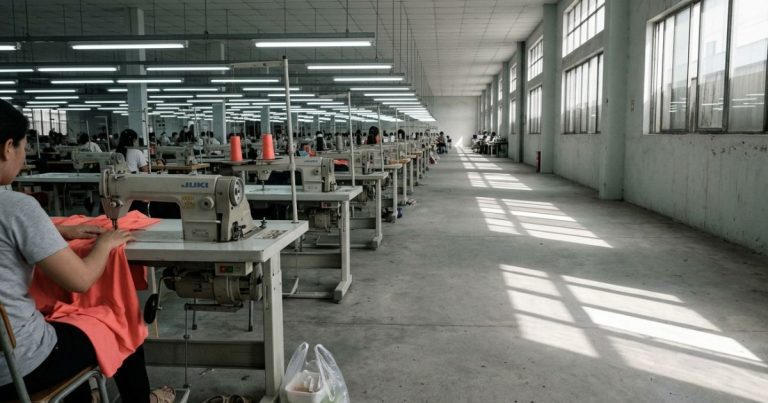
None of the market growth has reached the hands that sew the garments. This is the part of the story that no efficiency gain or policy reshuffle has touched. Across the industry, garment workers earn on average around 41 percent less than a living wage, the income needed to cover food, housing, and healthcare. The legal minimum tells the same story. In India it sits at roughly 31 percent of a living wage, and in China and Bangladesh around 37 percent.
Bangladesh, the world’s second-largest garment exporter, raised its minimum wage to 12,500 taka, around 113 dollars a month, in late 2023, after protests that left workers dead and hundreds arrested. Unions had asked for 23,000 taka as the floor for a dignified life. Because the wage is reviewed only once every five years, inflation eats it steadily between reviews, and the purchasing power of Bangladeshi garment wages ranked lowest among major apparel producers in a 2024 US trade analysis.
The pressure does not start with factory owners alone. Human Rights Watch documented how brands’ own purchasing practices, setting low target prices and refusing to absorb higher labour costs, push suppliers to resist wage rises. A company can support a living wage in public while pricing its orders in a way that makes one impossible. The labour organiser Kalpona Akter put it more plainly than any report could: workers are not asking for relief programmes or training, only that the laws be enforced and that brands add a little more to the price of every garment.
Less than 2 percent of the roughly 60 million garment workers worldwide earn a living wage. Around three quarters are women, most between 18 and 35.
This is the ground our own work stands on. It is why Thrive Ethical Fashion is built around fair wages and skilled craftsmanship rather than speed and volume. For the fuller picture of who absorbs these costs, see the social cost of fast fashion and the connection between fast fashion and modern slavery.
Where the clothes go to die
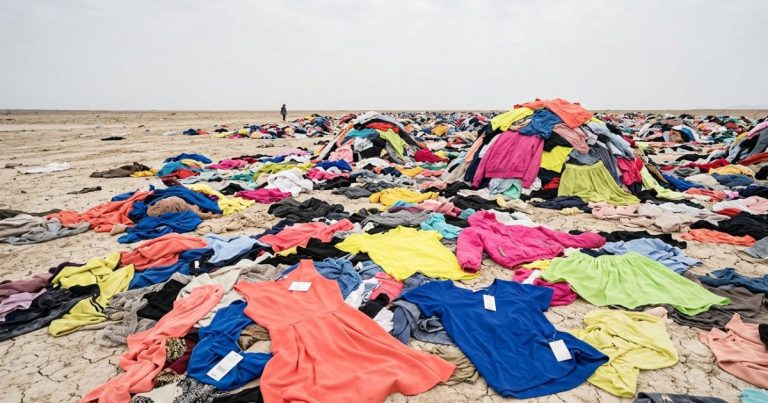
Every garment that is bought has to end up somewhere, and a growing share ends up in the Global South, sold secondhand and then, when it cannot be sold, dumped. Ghana is the clearest case. Every week roughly 15 million garments arrive at the country’s ports, most bound for Kantamanto Market in Accra, one of the largest secondhand markets in the world. Tens of thousands of traders, many of them women, make a living there mending and reselling.
The trouble is what cannot be sold. The OR Foundation, a charity that works with Kantamanto traders, estimates that around 40 percent of clothing imports become waste almost immediately, much of it burned or dumped. The Ghana Used Clothing Dealers Association disputes that figure and puts the share far lower, nearer 5 percent, which is part of why independent data matters here. Either way the city is overwhelmed. Around 100 tonnes of garments leave the market daily as waste, and Accra can process only 30 tonnes. The rest goes into open drains, lagoons, wetlands, and the sea. Traders describe the quality of the bales falling year on year, the disposability of fast fashion following the clothes all the way to the end. On New Year’s Day 2025 a fire tore through Kantamanto, wiping out thousands of livelihoods in a night and showing how thin the margins are for the people at the receiving end of the trade.
A polyester shirt worn five times in Europe can spend the next several centuries as waste in a West African wetland. The cost did not disappear when the shirt was thrown away. It moved.

What we are learning about the clothes on our backs
The case against fast fashion has usually been argued on two grounds, environmental and ethical. A third is arriving: human health. The synthetic fibres that make up most fast fashion shed microplastics constantly, not only in the wash but through ordinary wear, and the research tracing where those fibres end up is moving quickly.
In early 2025 a study in the journal Nature Medicine found microplastics building up in human brain tissue at higher concentrations than in the liver or kidney, with the levels in samples from 2024 notably higher than in those from 2016. A 2026 review in Environmental Science and Technology looked specifically at textile-derived micro and nanoplastics shed from polyester, acrylic, and nylon, and found growing evidence they can cross the blood-brain barrier, with possible links to oxidative stress and neuroinflammation, both implicated in neurodegenerative disease. A single wash of synthetic clothing can release between 1,900 and 700,000 microfibres, and synthetic garments also shed fibres into indoor air, which are then breathed in.
I want to be careful here, because the science is young and the long-term health picture is not settled. The Nature Medicine authors are explicit that they found accumulation, not proof of harm, and no safe threshold has been set. But the evidence points consistently enough in one direction that environmental groups are now pressing regulators to treat the reduction of synthetic textiles as a public-health question, not only an environmental one. The cheap polyester shirt and the particle later found in a bloodstream are the same material at two ends of its life.
What people are choosing instead
The most hopeful number in this report does not come from a regulator. It comes from shoppers. The global secondhand apparel market reached 393 billion dollars in 2025, around 10 percent of all apparel spend, according to the annual resale report from ThredUp, an online resale platform. In the United States the secondhand market grew nearly four times faster than the broader retail clothing market, and Gen Z and Millennials are expected to drive more than 70 percent of resale growth through 2030.
Some of this is economic. With tariffs lifting the price of new imports, 59 percent of consumers say they will turn to secondhand if new clothing gets more expensive. But the more interesting signal is a shift in default. Among younger shoppers, 55 percent say that if they can find an item secondhand, they will not buy it new. Buy-it-new-by-default is no longer the reflex it was.
Resale is one route. Buying less and choosing better is the other, and it needs no platform at all. A garment worn a hundred times costs a fraction, per wear, of one worn five times and discarded. Longevity is the most accessible environmental choice in fashion. It asks for no new technology and no new law, only the intention to keep a thing. For where to start, see our guides to alternatives to fast fashion and brands that are not fast fashion.
Where this leaves us
Put the year together and you get an industry under outside pressure for the first time. The line is still climbing, but the cheap-by-default model now runs into closed customs loopholes, producer-responsibility fees, advertising bans, greenwashing fines, marketplace investigations, and a generation quietly changing its buying habits. No single one of these turns the line around. Together they end the era when overproduction met no resistance at all.
What does not change is the arithmetic. Someone makes every garment. Someone is paid, or underpaid, to make it. Somewhere it is buried or burned when it is done, and more and more that somewhere is a wetland a long way from where it was worn. The work in front of the industry, and in front of the rest of us, is to make those people visible again and let what we see shape what we buy. Someone always pays the difference between a cheap price and a true cost. The only question is who, and whether you can see them from where you are standing.
That is the whole of the Mosaic idea. The maker comes before the product. Choose a piece from Thrive Ethical Fashion or from one of the makers in our artisan directory and you are choosing a supply chain you can see the end of. If you are in Chiang Mai, the doors are open Monday to Saturday. Order a cup of coffee, take your time, and look at what slow, dignified work actually produces.
Frequently asked questions
Is fast fashion declining in 2026?
No, not in sales. The global market is still projected to grow, reaching around 178 billion dollars in 2026 on the way to 388 billion by 2034. What is declining is the freedom the model used to operate with. Tariffs, the end of duty-free parcel shipping in the US and EU, producer-responsibility laws, and greenwashing fines have all arrived in the space of a year. Growth in volume and pressure on the model are happening at the same time.
Why did Shein and Temu get more expensive?
Both built their prices on duty-free shipping of low-value parcels. The United States ended that exemption for all countries in August 2025, and the EU agreed a 3-euro per-item customs duty on small parcels from July 2026. A dress that shipped for 20 dollars now lands nearer 30.
What is the new EU law on fast fashion?
There are several running at once. Producer responsibility for textile waste took effect in October 2025, the Digital Product Passport for textiles arrives from July 2026, and the Empowering Consumers Directive bans unsubstantiated green claims from September 2026. France has gone further with a dedicated anti-fast-fashion law aimed at Shein and Temu.
How much do garment workers actually earn?
Less than 2 percent of the roughly 60 million garment workers worldwide earn a living wage. In Bangladesh the legal minimum is around 113 dollars a month, well below what unions calculate is needed to live with dignity.
What is the most effective thing I can do about fast fashion?
Keep clothes longer. A garment worn a hundred times costs a fraction, per wear, of one worn five times and thrown away, and it needs no new technology or law. After that, buy secondhand, which is now growing nearly four times faster than new retail in the US, and choose makers who can show you their supply chain.
Continue reading
- Fast fashion statistics, the verified numbers
- The social cost of fast fashion, who really pays
- The hidden costs of fast fashion
- Alternatives to fast fashion that actually work
- Brands that are not fast fashion, a vetted list
- Fast fashion and microplastics
- Fast fashion and modern slavery
- Thrive Ethical Fashion, made in Chiang Mai
Every figure in this report links to its original source. Where estimates differ, we have noted the disagreement. This report was researched and written by the Mosaic Project team and reflects the most reliable data available as of June 2026.