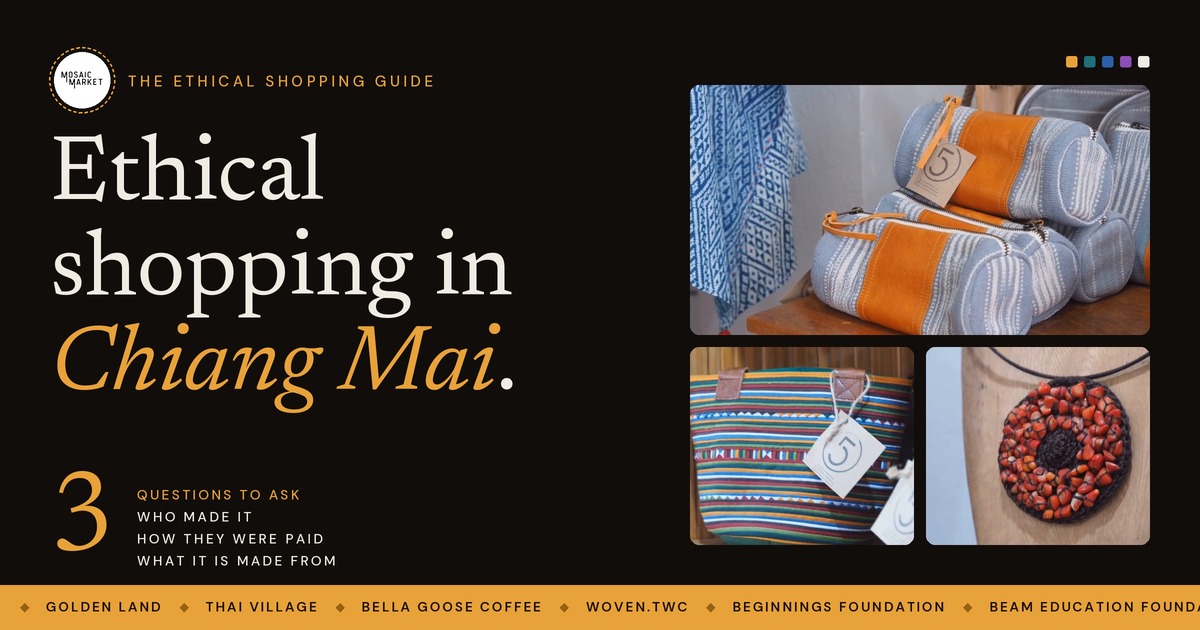

Ethical shopping in Chiang Mai comes down to three plain questions: who made this, how were they paid, and what is it made from. A shop that can answer all three has done most of the work. The answers are easier to find than most visitors expect, from coffee grown by Akha farming families to clothing sewn in a fair-wage workshop, and several of them sit on the shelves at Mosaic Market, the ethical café, slow fashion boutique and artisan marketplace at 164/62 Changklan Road, a freedom business of Rise Foundation Asia.
The numbers behind a fair price
- 380 baht a day is the minimum wage in Mueang Chiang Mai district, unchanged since July 2025. The rest of the province is on 357 baht.
- 9,880 baht a month is what 380 baht comes to over a 26-day month, before deductions.
- Fewer than 2 percent of the roughly 60 million garment workers worldwide earn a living wage.
- US$2.00 a pound will be the Fairtrade minimum price for washed Arabica coffee from 1 December 2026, up from $1.80.
- 8,633 hectares make up the Chiang Rai coffee area, Thailand’s largest coffee province, and 99.5 percent of it is Arabica.
- About 6.7 million people visited Chiang Mai in the first six months of 2025, 4.8 million of them from within Thailand.
Start with the price, then ask what it hides
Price is the first thing anyone notices and the weakest proof of anything. A low price can mean an efficient workshop. It can also mean someone’s wage was cut to reach it.
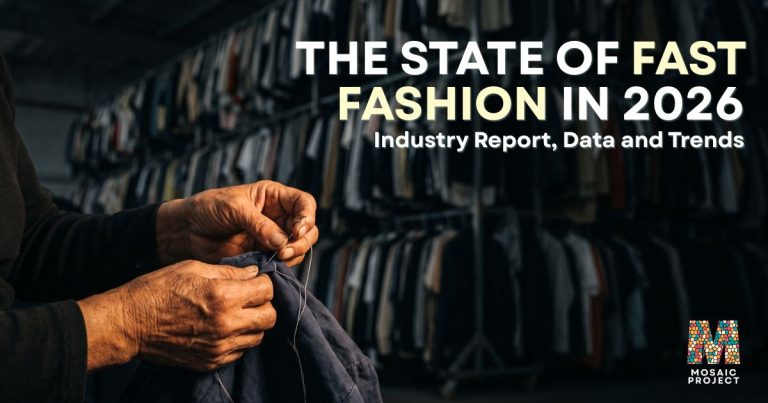
The garment industry shows the problem most clearly. The Mosaic Project’s 2026 fast fashion report records how few workers are paid enough to live on.
Fewer than 2 percent of the roughly 60 million garment workers worldwide earn a living wage.
Coffee, skincare and gifts raise the same question. For a closer look at who carries the cost of cheap clothing, read about the hidden costs of fast fashion.
Thailand sets its minimum wage by province and by the day. In Mueang Chiang Mai district it is 380 baht, and in the rest of Chiang Mai province it is 357 baht, according to Baker McKenzie’s summary. DLA Piper confirms the rates were left unchanged from 1 July 2025. The rates are reviewed from time to time, so the Ministry of Labour holds the current figure.
A minimum wage is a floor and not a living wage, and it only helps the people who actually receive it. A 2014 study by the Clean Clothes Campaign and the MAP Foundation spoke to 58 migrant workers in garment factories around Mae Sot, in Tak Province. They were typically paid 150 to 180 baht a day against a legal minimum of 300 baht, and none of them knew which brands they were sewing for. The study is more than a decade old and the sample is small, but it shows why “made in Thailand” says nothing about who made it or what they earned.
Chiang Mai also sells to a great many people. The city welcomed about 6.7 million visitors in the first six months of 2025, 4.8 million of them domestic travellers. At that volume, it matters who is behind the things on the shelf.
Five questions to ask any shop or maker
- Who made it? A named maker, workshop or cooperative is a better sign than “handmade in Thailand”. A name can be checked. A phrase cannot.
- How are they paid? Look for a stated wage practice that meets the 380 baht legal minimum in the city and ideally goes beyond it. A fair-wage workshop can describe its practice. A slogan cannot.
- What is it made from? Traceable material, such as shade-grown coffee from named highland farmers or remnant textiles that would otherwise be thrown away, is easier to trust than a vague claim of natural or eco.
- Which certification covers it? Fairtrade International certifies specific products such as coffee and cocoa. The World Fair Trade Organization verifies fair trade enterprises as a whole. The Global Organic Textile Standard covers the processing of organic textile fibres. Each covers something different, and a certificate for one product does not cover a whole shop.
- Does the price leave room for the maker’s time? A price pushed below the cost of the hours behind it means someone absorbed the difference. Fixed prices at a shop or workshop usually reflect real production costs. Bargaining at a market works best when it stops before that point.
What a coffee label leaves out
Chiang Rai province holds Thailand’s largest coffee area, 53,957 rai or about 8,633 hectares, and almost all of it, 99.5 percent, is Arabica. Much of it grows in highland communities. Minority Rights Group counts about 925,000 officially recognised highland people in Thailand and notes that broader estimates reach about 6 million, with land and citizenship disputes still acute. The Akha, one of the groups growing coffee, number about 80,000 in Thailand by one widely quoted estimate.
Fairtrade International sets a global floor price for farmers. From 1 December 2026 the Fairtrade minimum for washed Arabica rises to US$2.00 per pound, up 20 cents from $1.80. The Fairtrade Premium stays at 20 cents per pound and the organic differential at 40 cents. The floor only applies when market prices drop below it, and the arabica market price has not fallen below $2.00 since March 2024. It works as a safety net, and farmers can earn more than the floor when the market is higher.
So the useful questions for any coffee on a Chiang Mai shelf are which certificate it carries, what the roaster pays the farming families, and who those families are.
Where to start at Mosaic Market
Coffee. Mosaic Brew is specialty coffee sourced from Akha farming families in the highlands of Northern Thailand, shade-grown, hand-picked and roasted in small batches in Chiang Mai. It comes in three roasts, Medium, Medium-Dark and Dark, in 250g bags. The origin story is told in Northern Thai Coffee.
Clothing. Thrive Ethical Fashion is a fair-wage garment workshop and fashion brand, made in Chiang Mai and built around fair wages and skilled craftsmanship rather than speed and volume.
Woven textiles. Five Tribes Fair Trade carries hill tribe woven textiles, bags and cushions.
Upcycled textiles. Swahlee works in northeast India with upcycled remnant textiles. It is not a Thai maker, and the same questions apply to it.
Skincare. Pure Thai Naturals makes organic skincare in Chiang Mai using herbs from Karen communities.
Beeswax wraps. Superbee makes beeswax wraps in Chiang Mai, a practical replacement for plastic film.
Chocolate. Siamaya Chocolates sits on the same shelves and has its own profile.
Pantry goods. Roots Myanmar makes organic nut butters and sesame products with farmer cooperatives.
Gifts with a story. Golden Land Solidarity Collective works with artisans displaced by conflict and makes Shan tea pouches and small dolls. Eden makes jewellery with survivors of exploitation. Both are listed, with the other makers, in the artisan directory.
For gift-sized ideas by budget, browse handmade gift ideas.
Crafts with a name on them
Some northern crafts carry a legal marker of origin. A geographical indication, or GI, ties a product to a place and to a standard of quality, and Thailand’s Department of Intellectual Property administers a Thai GI logo for registered goods.
Chiang Mai Celadon is registered as a GI. It is stoneware glazed with wood ash, made in Doi Saket district, with a jade-green glaze that traces back to the Lanna Kingdom. The World Intellectual Property Organization praised Doi Saket’s makers as high-potential GI products.
Bo Sang umbrellas are also registered. The craft carries about 200 years of Lanna heritage, and it is under pressure. Makers told the Thai News Agency that the current generation is ageing, that almost every household in the village was making frames five years ago, and that too few young people are taking up the work.
Yok Dok brocade silk from neighbouring Lamphun is another registered northern product, and WIPO singled it out for its potential.
A GI protects the name and the standard of the product. It says nothing about labour conditions, so the five questions above still apply. What it does give a buyer is a way to tell a real Bo Sang umbrella or piece of Chiang Mai celadon from a lookalike, and a reason to buy from the people keeping the craft alive.
Beyond one shop
Much of Chiang Mai’s craft tradition is sold outside any single shop: the weekend walking streets, the artists’ village at Baan Kang Wat, the woodcarvers of Baan Tawai. The artisan markets guide covers each one, with days, locations and ways to tell handmade work from factory goods. The thinking behind a curated venue is set out in ethical marketplaces.
Four signs that deserve a second look
A uniform finish at a very low price usually points to a factory. A story with no named person attached is a story and not a source. A certification logo with no stated scope may cover only one ingredient or one process. A phrase such as “hill tribe style” describes a look and says nothing about who earned from it. None of these proves a problem. Each is a reason to ask the five questions before paying.
Visiting Mosaic Market
Mosaic Market is at 164/62 Changklan Road, Chang Khlan, Mueang Chiang Mai 50100, and is open Monday to Saturday. Mosaic Café, where Mosaic Brew is served, shares the ground floor with the shelves, and every maker stocked is named in the artisan directory. The meeting spaces upstairs can be booked. Order a coffee, take your time, and ask about the makers. Questions in advance are welcome through the contact page.
Frequently asked questions
What is ethical shopping? Choosing what to buy by how it was made, who made it and how they were paid, and not by price and appearance alone. A good test is a seller who can name the maker, describe how the maker is paid and say where the materials came from.
Where can I buy ethical products in Chiang Mai? Mosaic Market, open Monday to Saturday, stocks fair-wage clothing, specialty coffee, woven textiles, skincare and gifts from named makers. The weekend walking streets and the Baan Kang Wat artists’ village sell directly from makers, and the artisan markets guide covers them.
What is the minimum wage in Chiang Mai? In Mueang Chiang Mai district the minimum wage is 380 baht a day, about 9,880 baht a month at 26 working days. In the rest of the province it is 357 baht a day. These rates have been unchanged since 1 July 2025. A minimum wage is a legal floor and not the same as a living wage.
Is fair trade the same as ethical? No. Fair trade is a defined system with published standards and, for some products, independent certification. Ethical is a wider word with no single legal definition, so it is worth asking a seller what they mean by it.
What is the Fairtrade minimum price for coffee? From 1 December 2026 the Fairtrade minimum price for washed Arabica is US$2.00 per pound, up from $1.80, plus a Fairtrade Premium of 20 cents per pound. The minimum acts as a safety net when market prices fall below it.
What does GI mean on Thai crafts? GI stands for geographical indication. It links a product to its place of origin and a standard of quality, as with Chiang Mai celadon and Bo Sang umbrellas. It protects the name and the craft but does not certify wages or working conditions.
How can I tell handmade from factory-made? Handmade pieces tend to show small variations and visible tool marks, and the seller can describe the process. Very uniform goods at very low prices are usually factory-made. The artisan markets guide gives category-by-category tells.
Can I buy Mosaic Brew coffee outside Chiang Mai? Yes. Mosaic Brew is sold in 250g bags in three roasts, Medium, Medium-Dark and Dark, in store and online across Thailand.