
Chiang Mai has more markets than most visitors expect and fewer genuinely artisan ones than the number would suggest. The city’s reputation as a craft hub is well-earned — northern Thailand has extraordinary depth in textile weaving, silversmithing, ceramics, and woodwork — but the line between handmade-by-a-maker and handmade-printed-on-a-tag requires some navigation.
This guide covers the markets and spaces where the goods are actually made by the people selling them, or sourced with enough transparency that you can trust the story behind what you’re buying. It also covers where to find ethically produced Thai goods year-round — not just on market nights — and what to look for so you leave with something that will still feel meaningful once you’re home.
A note on timing: Chiang Mai’s market scene shifts with the season and occasionally with city planning decisions. The information below reflects the current situation as of 2026, but it is always worth checking before you go.
Why Chiang Mai has such a strong craft tradition
The answer lies in geography and history. Chiang Mai was the capital of the Lanna Kingdom — a distinct northern Thai civilisation that predates the integration of the north into Siam — and it developed its own artistic traditions in relative isolation from Bangkok. The city blends tradition with modernity, and its artisanal scene reflects both — from ancient craft techniques passed down through generations to contemporary design studios pushing those traditions into new forms.
The surrounding highlands add another layer. Hill tribe communities — Akha, Karen, Hmong, Lisu, Lahu, and others — have their own distinct textile, silversmithing, and weaving traditions. As these communities have urbanised and connected to tourism markets over the past few decades, their craft knowledge has increasingly found its way into Chiang Mai’s retail and market ecosystem. Buying from verified sources matters here: the difference between an artisan community capturing fair value for generational knowledge and a factory replicating their patterns for pennies is real, and worth caring about.
This is also the broader mission behind Mosaic Market and the artisan brands it works with. The artisan directory at Mosaic lists every maker it stocks — because transparency is the starting point for ethical trade, not a nice extra.
The Sunday Walking Street — Chiang Mai’s biggest market
Ratchadamnoen Road, Old City. Every Sunday, 4pm to midnight (approximately).
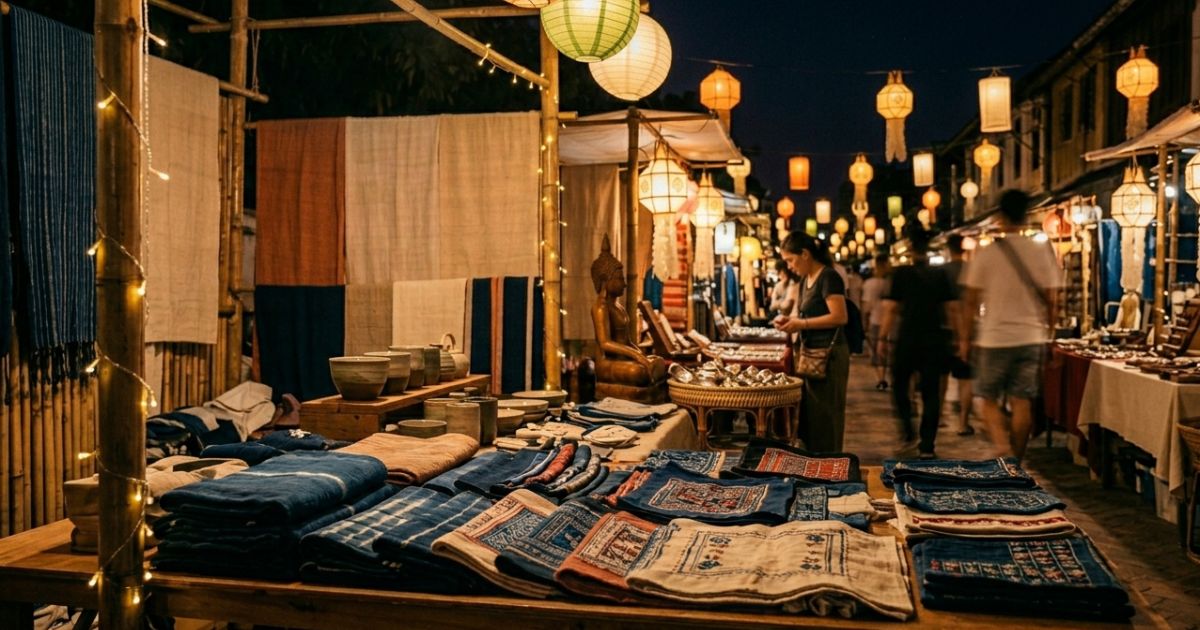
The Sunday Walking Street runs from Tha Phae Gate straight down Ratchadamnoen Road through the heart of the Old City. Every Sunday from 4pm until around midnight, this entire stretch transforms into what might be Thailand’s most impressive weekly market — roughly one kilometre of road packed with vendors, artisans, musicians, and food stalls.
Handmade crafts are the main event. It is one of the best places in Chiang Mai to shop directly from local makers — art, textiles, jewellery, soaps, and small décor items — so your souvenirs feel personal rather than mass-produced.
The atmosphere on a clear Sunday evening is genuinely special: the Old City road closes to traffic, candlelight and lanterns appear at the stalls, and the scale of it creates something between a market and a street festival.
What to look for here: indigo-dyed clothing, patterned textiles, handmade silver jewellery, ceramic work, wood carvings, and hand-painted umbrellas.
These are the categories where you are most likely to find genuine handmade work rather than imported goods. The food stalls are also exceptional — sai ua (northern spicy sausage), khao niew mamuang (mango sticky rice), and dishes you will not find at standard tourist restaurants.
The honest caveat: the Sunday Walking Street is large enough that quality varies dramatically stall by stall. For every maker selling their own work, there are vendors with factory goods that look similar. The tells: genuine handmade pieces have slight variations, visible tool marks, and a maker who can tell you about the process. Suspiciously uniform pieces at very low prices are almost always not what they appear.
The Saturday Walking Street — Wua Lai Road
Wua Lai Road (south of the Old City). Every Saturday, 4pm to midnight.
The Saturday market is the better-kept secret of the two walking streets. Wua Lai Walking Street is renowned for its strong connection to local artisans, historic silver-making workshops, and its relaxed, less touristy vibe. The road it runs along was historically Chiang Mai’s silversmith district — silver jewellery lovers will be in paradise here, with artisans displaying intricate designs, some even offering custom-made pieces, where you can observe the craftsmanship and dedication that goes into each creation.
The practical experience is calmer than Sunday — fewer visitors, easier to browse, more space to actually talk to the people making things. The Saturday Night Market specialises in high-quality silver jewellery and ceramics from traditional craftspeople. Nearby Wat Sri Suphan — the Silver Temple — is one of Chiang Mai’s most extraordinary buildings and worth combining into the same evening.
If you can only choose one walking street, Saturday suits serious craft buyers better. Sunday suits people who want the full spectacle.
Baan Kang Wat — the artists’ village
Suthep Road, near Wat Ram Poeng. Open Tuesday to Sunday, 11am to 6pm (approximately). Sunday market from 8am.
This is the place most worth knowing about if you care about the provenance of what you’re buying. Baan Kang Wat is a small community of independent shops and businesses made up of around ten unique houses, centred around an outdoor communal area and amphitheatre. All the creative businesses found at the village focus on local, handmade, sustainable and organic products.
Baan Kang Wat is a craft community and living art village formed by more than 30 artisans working and living together. The community brings together creators from diverse fields, including painting, sculpture, embroidery, fabric dyeing, bookbinding, basketry, leatherwork, and other handmade crafts.
Each little wooden house in the artist complex has its own charm — selling everything from handmade ceramics to art prints, slow fashion, sustainable goods, and even locally made skincare. The key difference from the walking streets: here you are often buying directly from the person who made the thing in the same building where they made it. There is no ambiguity about provenance.
The village is full of small, green pathways leading to pretty shops and artsy stores. Some artists even offer classes and workshops that visitors can join. It is also a sustainable, eco-friendly setup that is completely plastic-free.
Workshops in pottery, painting, watercolour, and bookbinding run regularly — check the Baan Kang Wat social channels before visiting for current schedules.
It sits about 15 minutes by Grab from the Old City. Go in the morning on Sunday when the full market is running. Combine it with a visit to nearby Wat Umong, one of Chiang Mai’s most atmospheric forest temples.
JJ Market (Jing Jai) — farmers market with a craft dimension
Atsadathon Road (north of the Old City). Saturday and Sunday, 7am to 1pm.
Chiang Mai’s Jing Jai Market is a famous open-air market that combines the farmers market, organic market, flea market, and creative craft market. It sells healthy organic fruits, vegetables, and agricultural products from Chiang Mai’s highland farmers. The Rustic Market held every Sunday has the most extensive collection of handmade products in Chiang Mai.
JJ Market is primarily a food and produce market — the organic farmers’ section, the live music in the morning, the communal seating under the trees — but the Sunday Rustic Market segment has genuinely good handmade goods. It is a morning experience: go before noon, when vendors start packing up. The combination of specialty coffee, organic highland produce, and handmade craft in one space makes it one of the most pleasant ways to spend a Sunday morning in Chiang Mai.
This is also the only market in Chiang Mai that proactively promotes sustainable packaging, with many vendors using banana leaf food trays and paper straws. That signals something about the values of the vendor community here.
Mosaic Market — curated ethical retail, open year-round
Mosaic Market, Chiang Mai. Open Monday to Saturday, 9am to 6:30pm.
The markets above are weekly or weekend-only. For ethically sourced handmade goods on any day Monday through Saturday, Mosaic Market is the answer. It operates differently from a market: every brand and product is pre-vetted, makers are named and documented in the artisan directory, and the supply chain transparency that you have to intuit at a night market is built into the model.
The space combines Mosaic Café — specialty Mosaic Brew coffee, locally roasted — with a retail floor stocking brands including Thrive Clothing, Swahlee, Five Tribes Fair Trade, Threads of Gold, Siamaya Chocolates, Pure Thai Naturals, and SuperBee. Each brand has its own story and sourcing documentation.
For visitors who want to understand what they are buying, have a conversation about it, and sit down with a good coffee while they think it over — this is the practical alternative to navigating a large night market on your own.
Baan Tawai Village — the woodcarving district
Han Dong District, approximately 15km south of central Chiang Mai.
Baan Tawai is not a market in the walking-street sense — it is an entire village built around the woodcarving trade. This artisan village is renowned for its skilled woodcarvers, who create intricate sculptures, furniture, and decorative items. As you explore the village, you have the opportunity to meet the artisans and watch them at work, gaining insight into their craft. Glooob
It is a destination for people buying furniture, large decorative pieces, or antique-style wooden objects. Smaller, portable items — carved figurines, bowls, picture frames, decorative panels — are also available and reasonable to take home. The quality varies significantly between workshops, so it is worth walking the full length before committing to a purchase.
What to buy — and how to tell handmade from factory-made
Across all of Chiang Mai’s markets, a few categories consistently deliver genuinely handmade quality:
Textiles and indigo-dyed clothing are the strongest category in northern Thailand. Hill tribe weaving traditions produce fabrics with complexity that factory production cannot replicate cost-effectively. Look for slight irregularity in pattern repetition — consistent with hand-weaving — and ask whether the dye is natural or synthetic.
Silver jewellery from the Wua Lai district and hill tribe silversmiths ranges from exceptional to tourist-grade. Genuine hand-worked silver has surface texture from hammering and tool marks. Cast pieces, which are factory-produced, have a smoother, more uniform surface.
Ceramics from the Chiang Mai studio tradition — particularly the celadon work the region is known for — are distinctive enough that quality is usually visible. Baan Kang Wat’s ceramic studios are a reliable benchmark.
Organic skincare and natural products — Pure Thai Naturals, SuperBee beeswax products, botanical soaps — are available both at Mosaic Market and increasingly at JJ Market. These are verifiable: GOTS certification and USDA Organic labels mean something.
For a broader guide to the best things to buy in Chiang Mai, including categories beyond craft markets, see the full buying guide.
Practical information
Most walking street markets run from approximately 4pm to midnight on their respective evenings. Arrive between 5pm and 7pm for the best balance of full stalls and manageable crowds. Arriving early evening avoids the worst of the crowds and gives better browsing conditions.
Bargaining is expected at walking street markets for craft goods, though less so at established shops and artisan villages like Baan Kang Wat where prices are generally fixed and reflect actual production costs. A useful principle: if bargaining a price down would mean the maker earns less than a living wage for the time the piece took, reconsider whether the price was the problem.
Getting around: the Old City walking streets are within easy walking distance of most central accommodation. Baan Kang Wat and JJ Market require a Grab or taxi — both are straightforward and inexpensive from the Old City. Baan Tawai is best reached by Grab or songthaew.
Frequently asked questions
What is the best artisan market in Chiang Mai?
For the full market experience, the Sunday Walking Street on Ratchadamnoen Road is the most impressive — one kilometre of stalls including genuinely handmade crafts, street food, and live performance. For higher confidence in provenance and a more relaxed experience, Baan Kang Wat artists’ village is the better choice: it is a permanent community of 30-plus makers where most goods are made on-site. For curated ethical retail any day of the week, Mosaic Market is open Monday to Saturday.
What handicrafts is Chiang Mai known for?
Northern Thailand is known for indigo-dyed textiles, hill tribe weaving, silver jewellery (particularly from the Wua Lai silversmith district), celadon ceramics, lacquerware, hand-painted umbrellas from Chiang Mai’s Bo Sang village, and teakwood carving. Several of these traditions are connected to specific ethnic communities — Akha, Karen, Hmong, Lahu, Lisu — whose craft knowledge is generational.
How do I know if goods at Chiang Mai markets are genuinely handmade?
Genuine handmade goods typically show: slight irregularities in pattern or form consistent with hand production, visible tool marks on metal or ceramic work, a maker who can describe the process and materials, and pricing that reflects actual labour time. Suspiciously uniform goods at very low prices are almost always factory-made. Shopping at permanent artisan spaces like Baan Kang Wat or curated ethical retailers like Mosaic Market removes this uncertainty.
What is the Saturday night market in Chiang Mai?
The Saturday Night Market — also called Wua Lai Walking Street — runs every Saturday evening from approximately 4pm on Wua Lai Road, south of the Old City. It is the smaller, quieter, and in many ways more artisan-focused of Chiang Mai’s two weekly walking streets, with particular strength in silver jewellery and traditional crafts. The nearby Silver Temple (Wat Sri Suphan) is worth combining into the same visit.
Is Chiang Mai good for ethical shopping?
Yes — Chiang Mai has a stronger concentration of ethical retail options than most cities in Southeast Asia. Mosaic Market curates verified artisan and fair trade brands and is open Monday to Saturday. Baan Kang Wat is a permanent artisan village where most goods are made on-site. JJ Market’s Sunday Rustic section has organic and handmade producers. For a full guide, see our ethical shopping in Chiang Mai guide.
Related reading: