A Human Trace Editorial Series Feature for Mosaic Market
Some crises don’t erupt suddenly.
They grow quietly — in kitchens, in clinics, in border towns, in the corners of policy conversations where children are rarely invited and rarely considered.
Statelessness.
Malnutrition.
Legal invisibility.
Early childhood deprivation.
These aren’t headline-grabbing emergencies.
They’re slow-burning realities shaping the lives of millions of children across Southeast Asia.
In The Human Trace conversation with Dr. Harfini Zainuddin, the scale becomes undeniable: We are normalizing neglect.
And children are paying the price.
The Numbers Tell One Story — Lived Reality Tells Another
According to global data, millions of children under five are malnourished, stunted, or legally invisible.
But Dr. Zainuddin brings the numbers to life, revealing what those statistics feel like in real communities:
- infants born into poverty who never receive proper nutrition
- toddlers who have never seen a clinic because their parents fear arrest
- five-year-olds who look two because their bodies are starving for micronutrients
- children who can’t enroll in school because they have no papers
- mothers who give birth while handcuffed because of their nationality
These are not isolated stories.
They are symptoms of structural neglect — of systems that do not see certain children as worthy of protection.
Malaysia’s “Triple Burden” of Malnutrition
One of the most alarming insights from the episode is the shift in Malaysia’s nutritional crisis. Before the pandemic, the country was already struggling with:
- stunting
- obesity
- wasting
But after years of lockdowns, economic fallout, and restricted access to care, a third crisis emerged:
1. Childhood stunting (from chronic undernutrition)
2. Childhood obesity
(from inconsistent diets and low-quality food)
3. Widespread anemia
in both pregnant mothers and young children
These are not small-scale issues.
They shape brain development, immunity, school readiness, lifelong health, and the economic future of entire communities.
A child who is malnourished at age two enters the world with disadvantages that echo through adulthood.
This mirrors the dynamics we’ve examined in Mosaic Market’s writing on systemic exploitation, such as: Fast Fashion & Modern Slavery
When systems fail, the vulnerable suffer first — and longest.
The Pandemic Didn’t Create the Crisis — It Exposed It
During the pandemic, Dr. Zainuddin received hundreds of messages a day from families begging for food.
Not support.
Not access.
Food.
Parents couldn’t work.
Infants were born underweight.
Toddlers lost critical developmental years.
Daycares and kindergartens closed — many permanently.
Children who were three in 2020 are now eight.
They have lived the majority of their lives without consistent nutrition, early learning, or safe healthcare access.
We talk often at Mosaic Market about the hidden cost of exploitation in consumer industries, explored in: The Hidden Costs of Fast Fashion
But here, the hidden cost is human potential.
Statelessness: When Your Existence Isn’t Recorded
Statelessness is not simply a missing birth certificate.
It is an erasure of identity — a lifetime of closed doors.
A stateless child:
- cannot enroll in public school
- cannot access healthcare
- cannot legally work
- cannot travel
- cannot be protected by the state
- cannot be recognized if exploited or abused
Statelessness ensures a child begins life several steps behind — and stays behind.
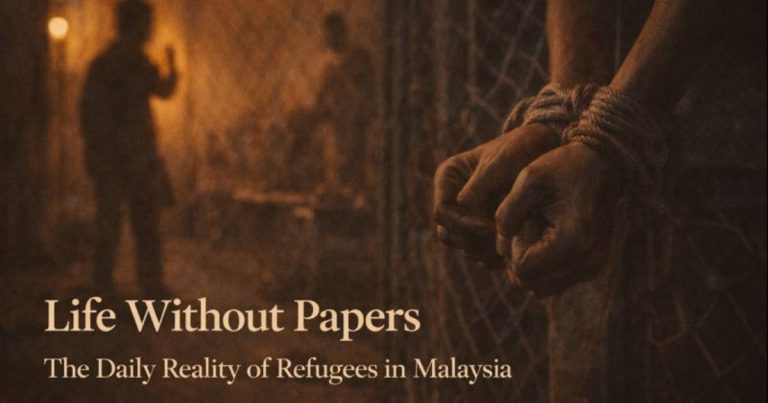
This connects directly to the realities we see among refugee artisans, where lack of documentation becomes a barrier to safety, opportunity, and dignity. Our feature on refugee life echoes this truth:👉 Life Without Papers: The Daily Reality of Refugees in Malaysia
Invisibility is not neutral.
It is dangerous.
Policy Gaps Become Humanitarian Emergencies
One of the most striking points Dr. Zainuddin raises is this:
“We are focusing on interventions instead of root causes.”
Governments address stunting but not anemia.
They address the “first thousand days” but not the years that follow.
They tackle obesity but ignore healthcare access.
Fragmented policies produce fragmented lives.
When the system prioritizes paperwork over people, children fall through the cracks — and stay there.
The Human Cost of Neglect
The crisis becomes clear when you look at the daily realities:
- children fainting in school from anemia
- toddlers showing developmental delays
- refugee mothers choosing between feeding their children and risking arrest
- stateless teens aging out of systems without a single right
- communities relying entirely on civil society for survival
- families who’ve lived five years without proper nutrition
These aren’t failures of individual families.
They’re failures of systems.
And yet, local advocates, teachers, healthcare workers, and community volunteers continue to fill the gaps — the same type of grassroots resilience Mosaic Market celebrates through partners like Thrive Ethical Fashion and Five Tribes Fair Trade.
Why This Matters to Mosaic Market
Many of the families we serve — especially those affected by displacement, conflict, or poverty — have lived these realities.
Some of the mothers in our artisan community gave birth without documentation.
Some children entered our programs malnourished.
Some households still choose between school fees and food.
To support these communities responsibly, we must first understand the forces shaping their lives.
This is why Mosaic Market’s storytelling is guided by dignity, not pity — explored in our Ethical Storytelling Guidelines.
Children are not case studies.
They are human beings with futures worth fighting for.
🎧 Listen to the Full Episode on The Human Trace
Hear Dr. Harfini Zainuddin describe the crisis from the frontlines — and the quiet revolution needed to protect the most vulnerable among us.